
AI-generated art as a tool
Some thoughts and opinions on the ethics, practicality and advisability of AI visuals
Three weeks ago I wrote what I thought was a fairly innocuous and random Note. It was sharing an emotional reaction that I was having at seeing an increasing number of Substacks that I read (of course not the many illustrators I follow, but I read a fairly wide gamut of newsletters here, not just those in the illustration world) picking the seemingly easy option of using the AI button to generate a visual for their newsletter.
I am absolutely not here to police anyone’s decisions to or reasons for using generative AI to create visuals (or words).
One of the things that came out in the responses (though, given that the bulk of the people who follow me are other illustrators, the vast majority of the responses were in agreement that they did not like seeing AI-generated visuals on Substack) was that AI-generation is only a new tool in the digital artist’s toolbox. Perhaps it will become as much a part of our process as the healing brush or channels in Photoshop or the symmetry function in Procreate or the pattern tool in Illustrator. A lot of these tools take away some aspects of process, or make it easier. It is not always the case that we lose out from using those tools, particularly if we are working in a fast-paced industry. Will we still be able to use AI generation and maintain some humanity behind it?
There are definitely actual artists and illustrators out there choosing to embrace and experiment with this new tool. Some using it for idea generation and then using their normal process and style to create the end piece, for example, in the same way that there are some writers out there using Chat GPT to create a structure or plan for a piece and then filling it with their own actual words.
A tool for the non-creatives
And it is particularly finding its usefulness for people who are not visually creative. As visual creators it is perhaps sometimes hard to appreciate that not everyone is comfortable doing so and that many people are not even comfortable at being able to source visual content. For some people this AI-generation is an incredibly powerful new tool for them, opening up a new world.
This thought came about after wondering whether I should actually allow AI to write some of the ALT tags and other SEO type information - for example, when I upload to a microstock site, there will be a number of auto-generated suggestions based on what the machine can interpret from the image I am uploading. A lot of it is useful (e.g. it can usually recognise that I’ve uploaded a pattern and often recognises the main colours, and sometimes even the actual content) and some of it is completely wrong. I will use these auto-generated items as the basis and then delete some of them and add some of my own that it won’t have been able to get from analysing the image (I think emotion is going to be one of those).
And the suggestion was that most writers wouldn’t have a problem with using AI to generate those.
But I realised that I know quite a lot of people who get paid to write ALT text for digital publications. It’s actually an incredible skill and one that takes a lot of thought and knowledge. If we start to just go with the auto-generated content we will (a) miss out on a lot of nuance that a machine genuinely cannot get and (b) take work away from people.
As someone who wants to spend my time drawing, rather than filling in forms after forms, this tool is really useful, because it saves me some time. I can’t rely entirely on the auto-generation, but it definitely reduces my effort a bit and it’s an effort that I have no desire to dig down and spend more time on.
Which I realised is exactly how some people will feel about auto-generating visuals. There are platforms, like Substack, that do pretty much expect at least one visual for any newsletter or post. And for some people that is so very very far from their comfort zone that even searching for a good visual from a single free source such as Unsplash will feel impossible. Are we going to forbid them from putting their writing out there because they can’t also find a human-generated visual to match, when they have a button they can press to generate something instead?
What do I have against AI-generated visuals?
I am coming out here more conflicted than when I wrote my initial Note. I am someone who has always embraced new features in software. I am always incredibly excited about big software updates and what new tools I’m going to get to play with. I’ve been using Adobe’s software for a very long time and I have, unlike many of my fellow creatives, genuinely loved the subscription model because it allows me to always have the most up-to-date version (previously we almost always skipped a version and upgraded every other new version because it was too much to spend in one go). I have genuine excitement when I see ‘you have XX updates’ pop up in the bottom right of my screen and disappointment when it turns out to be a security update or a bug fix (though the fact that we get these all the time and automatically I think it a wonderful feature of the subscription model).
Why, then, is the fact that almost every update over the last year and a bit has been adding new AI generation features annoyed me, made me sad and definitely not excited me? I loved the improvements to the remove background tool (though I still almost always have to do some manual cleaning up after using it - whether it’s removing a background from a photo for PowerPoint, or removing the background from a scanned painted motif).
But I have 100% no interest in pressing a button to generate literally any kind of visual. I have spent the past ten years or so learning more and more about illustration and pattern design and, as both a designer and an illustrator I never ever ever want to be using AI to create art. I need to be putting my humanity into anything I create.
Humanity and emotion
And I think that is the reason. Because it is taking away the humanity. And I find and feel no value whatsoever in a visual spat out of a machine-learning engine, but I find untold value in something created with the human mind and human hand (and that human hand can absolutely be holding an Apple Pencil or a mouse - there is a huge difference between AI-generated visuals and digital art).
Human-generated art has huge value. One of the most important benefits is that it holds and depicts emotion in a way that machine-learning will never be able to do.
For me everything I create and all the art (whether written or painted or however it is created really) that I consume digs deep into human emotion, whether in depicting it or just evoking it. AI-generated images and writing, by very definition, have no emotion. Are we at risk of moving away from understanding emotion if more and more of what we consume is created, or generated, without it?
Choose human-created art
So, I think, my overlying message is that I am absolutely not here to police anyone’s decisions to or reasons for using generative AI to create visuals (or words), but that I would ask all of you who are doing so or considering doing so whether you wouldn’t find and provide more value to your human readers and viewers by choosing human-created art instead.
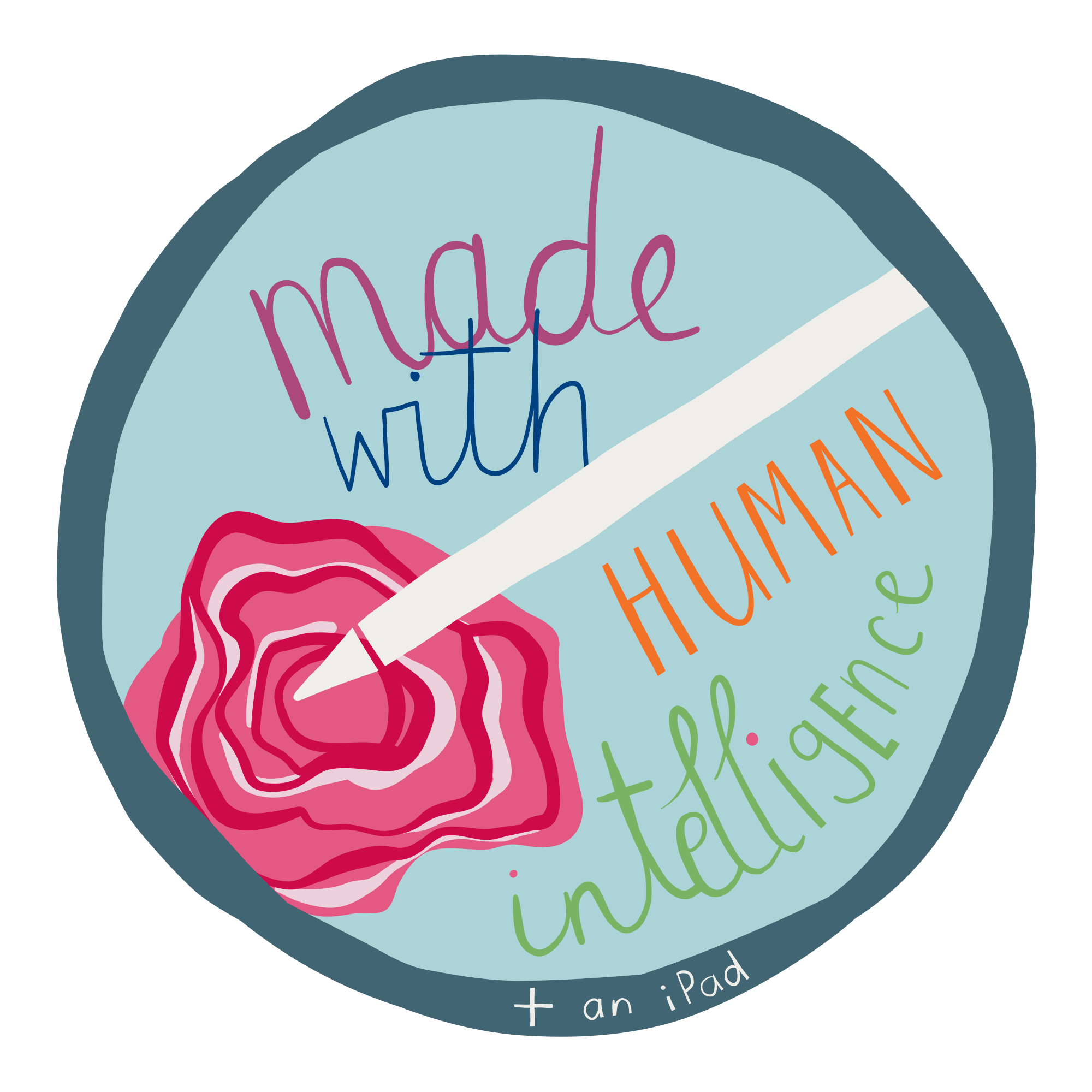
If you are a writer and choose not to use AI-generated visuals in your newsletter, you have my permission to use this badge to show your readers that you use human-generated images alone.
This is the first in a series of newsletters that will look into some of the responses from that Note I wrote three weeks ago. I’m not going to make this the anti-AI newsletter or anything, but I now have notes in my drafts for at least another two, and maybe three pieces on this topic, so I’ll aim to publish one a month, so as not to spam you with AI-related commentary when you’re looking to read about freelance life, the illustration business and my experiments with digital nomading.
Watch out later this evening for the introductory post of my brand new Substack all about plant-based food, with accompanying (human-generated) illustrations. If you want to make sure to see it, you can pre-subscribe (think of it like pre-ordering a book), but I’ll also drop a share into Notes when it’s published …
This is one of my favourite posts covering the situation so far. Thank you so much for this, Tasha. There's soooooo much I could say in reply, but I'll keep it to a couple of things for now and still likely write loads! :)
Many AI images look similar and are clearly AI. But that's not because AI images can all be identified with ease. It's mostly because peeps are using the same tools and only doing the basics with them. From my perspective of using multiple tools extensively over a couple of years, so much is possible that it's basically all about curation. It's not so much about creating art, and far more about finding pictures, if that makes sense.
I totally agree with you that everything adding AI services and making image generation stuff available is missing so much of the necessary discussion. In essence, many will see the tools without further thought, much like considering the things human beings can be paid for, like writing ALT text. That doesn't mean the roles must remain indefinitely and without change, but the public won't be aware of what's going on. Lacking awareness is different to being uncaring. That said, it's hard to know how much people will care if they weren't paying for those particular things in the first place.
And that makes Adam Ming's comment one of the most pressing. The legal and ethical situation is up in the air and showing no sign of sorting quickly. That's why I've explored so much of AI, but kept a majority of the learning behind the scenes. The level of what's possible already is bizarre, but the bulk of the content we see will come from a prompt in one of the many services touting AI-gens. We get to see a lot of those, even in these Substack newsletters, but that's not the limit of what AI images can look like.
Thank you again for the open discussion and looking at the different angles we're currently facing.
Thanks, Martin. It’s definitely a complex issue.